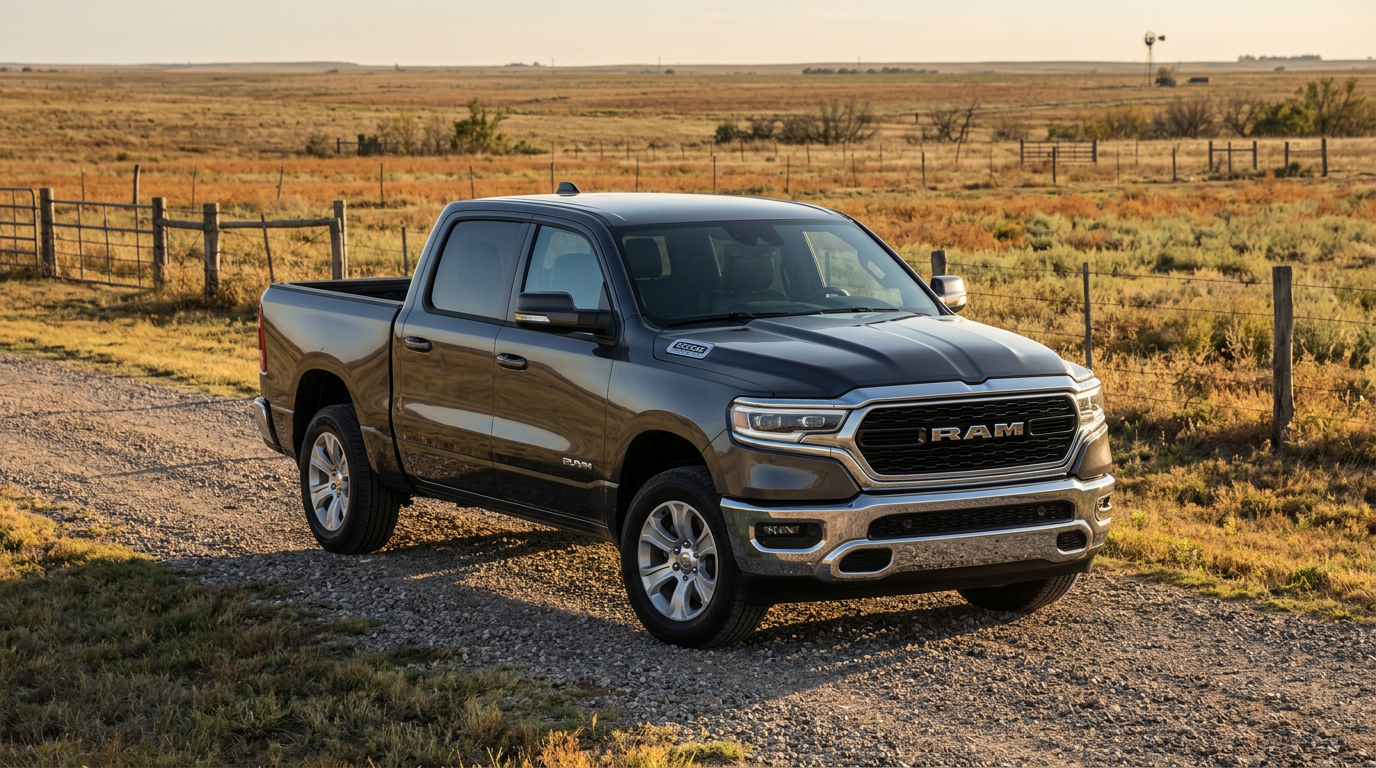




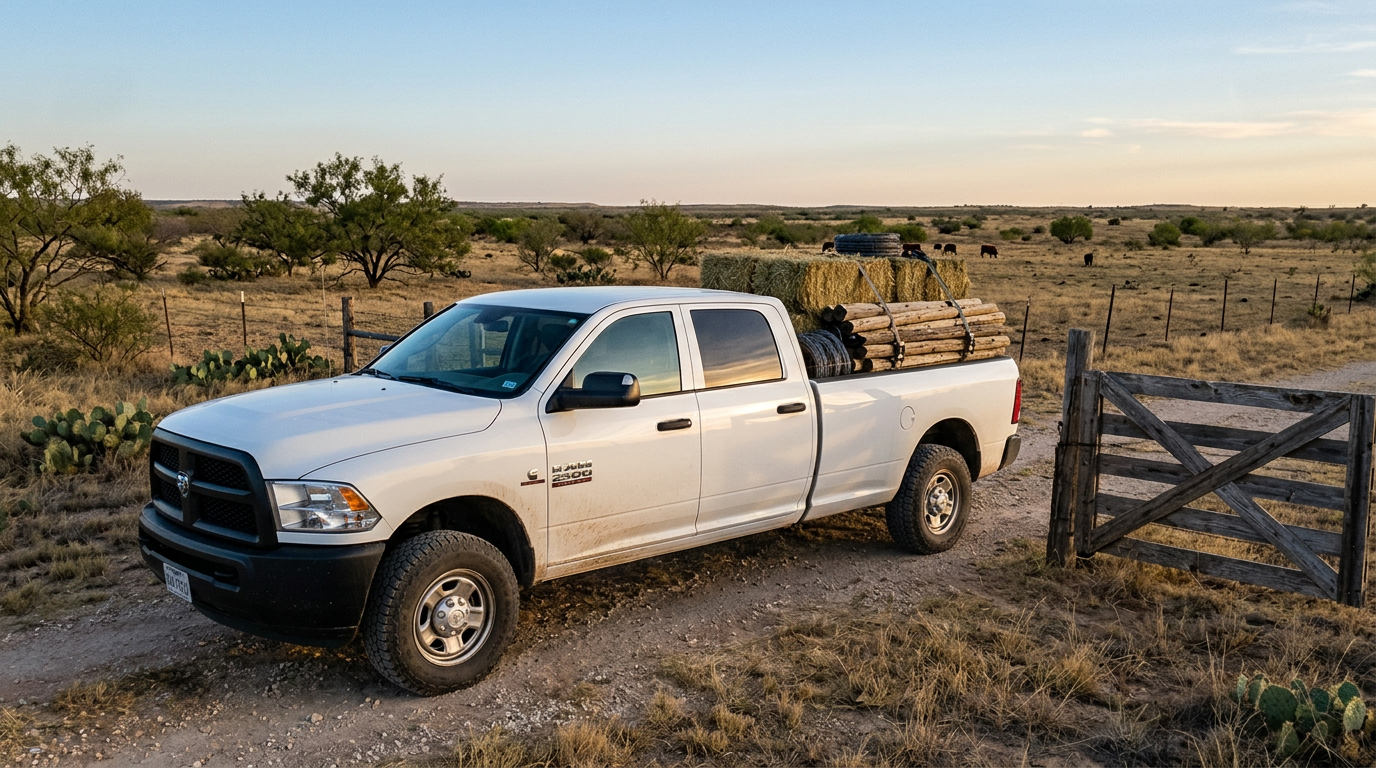
The 8-foot bed fits heavy Callahan County ranch work best because its 98-inch length accommodates standard 8-foot fencing, lumber, and full feed pallets flat with the tailgate closed while providing built-in cab clearance for gooseneck stock trailers. The 6-foot-4-inch bed works better for ranches prioritizing 6-passenger Crew Cab interior space and easier maneuverability through tight pasture gates and stockyards.
Choosing the right cargo box configuration for a heavy-duty work truck directly impacts daily operations across West Texas agricultural properties. The Tradesman trim serves as the dedicated workhorse of the Ram Heavy Duty lineup, built specifically for commercial durability without unnecessary fluff. When configuring a Tradesman, body style dictates available bed options: the Regular Cab comes exclusively with the 8-foot long bed, while the Crew Cab allows buyers to select either the 6-foot-4-inch standard box or the 8-foot long box.
For livestock operators around Clyde hauling bulk feed bags, fencing wire, or round bales, extra cargo floor length eliminates the need to drive with the tailgate down. However, ranch crews that frequently haul farm hands, family, or equipment tools in the second row often prefer the Crew Cab layout. Matching the bed size to daily farm chores ensures your truck handles heavy agricultural workloads efficiently. To inspect both bed configurations in person, visit our showroom on North Access Road or speak with our truck specialists directly at (325) 893-1416.
Table of Contents
- What Are the Exact Dimensions and Hauling Capacities of Ram 2500 Beds?
- How Does an 8-Foot Bed Improve Gooseneck Towing and Ranch Maneuverability?
- How Do Engine Choices Impact Payload Capacity and Trailering Fuel Economy?
- How Does the Ram 2500 Tradesman 8-Foot Bed Compare to the Ford F-250 XL for Farm Utility?
- Quick Answers for Callahan County Ranch Truck Buyers
- Find Your Next Ram 2500 Tradesman at Blake Fulenwider Chrysler Dodge Jeep
What Are the Exact Dimensions and Hauling Capacities of Ram 2500 Beds?
The 8-foot bed measures 98 inches in length with a total cargo volume of 75 cubic feet, offering 17 cubic feet of additional capacity over the 6-foot-4-inch bed, which measures 76 inches in length with 58 cubic feet of volume. Both bed sizes share identical width measurements of 66 inches overall and 51 inches between the wheel wells.
Understanding these interior dimensional differences helps determine how agricultural supplies fit into the cargo box:
- 6-Foot-4-Inch Bed: Measures 76 inches long, 66 inches wide, and 20 inches deep. Fits 58 cubic feet of cargo volume. Requires dropping the tailgate or using bed extenders to haul standard 8-foot lumber, plywood, or T-posts flat. Accommodates one large round hay bale or one standard cargo pallet between the wheel arches.
- 8-Foot Bed: Measures 98 inches long, 66 inches wide, and 20 inches deep. Fits 75 cubic feet of cargo volume. Allows 8-foot construction materials and fencing supplies to lie flat with the tailgate fully secured. Fits two standard feed pallets or two round hay bales stacked end-to-end behind the cab.
Width between the wheel wells remains 51 inches across both box lengths, meaning standard 4-foot-wide sheet goods lie flat on the floor in either setup. However, the extra 22 inches of floor length in the 8-foot box gives agricultural operators critical extra volume when loading loose items like fencing tools, generator units, or supplemental livestock feed.
Maximum payload capacity also varies by configuration. Because a Regular Cab chassis weighs less than a four-door Crew Cab, a Regular Cab Tradesman equipped with the 6.4L HEMI V8 achieves higher available payload capacity, reaching up to 4,580 pounds when properly equipped. Opting for a Crew Cab with an 8-foot bed adds frame weight, slightly lowering the net payload rating compared to a Regular Cab, but providing unmatched floor area for heavy supply runs.
How Does an 8-Foot Bed Improve Gooseneck Towing and Ranch Maneuverability?
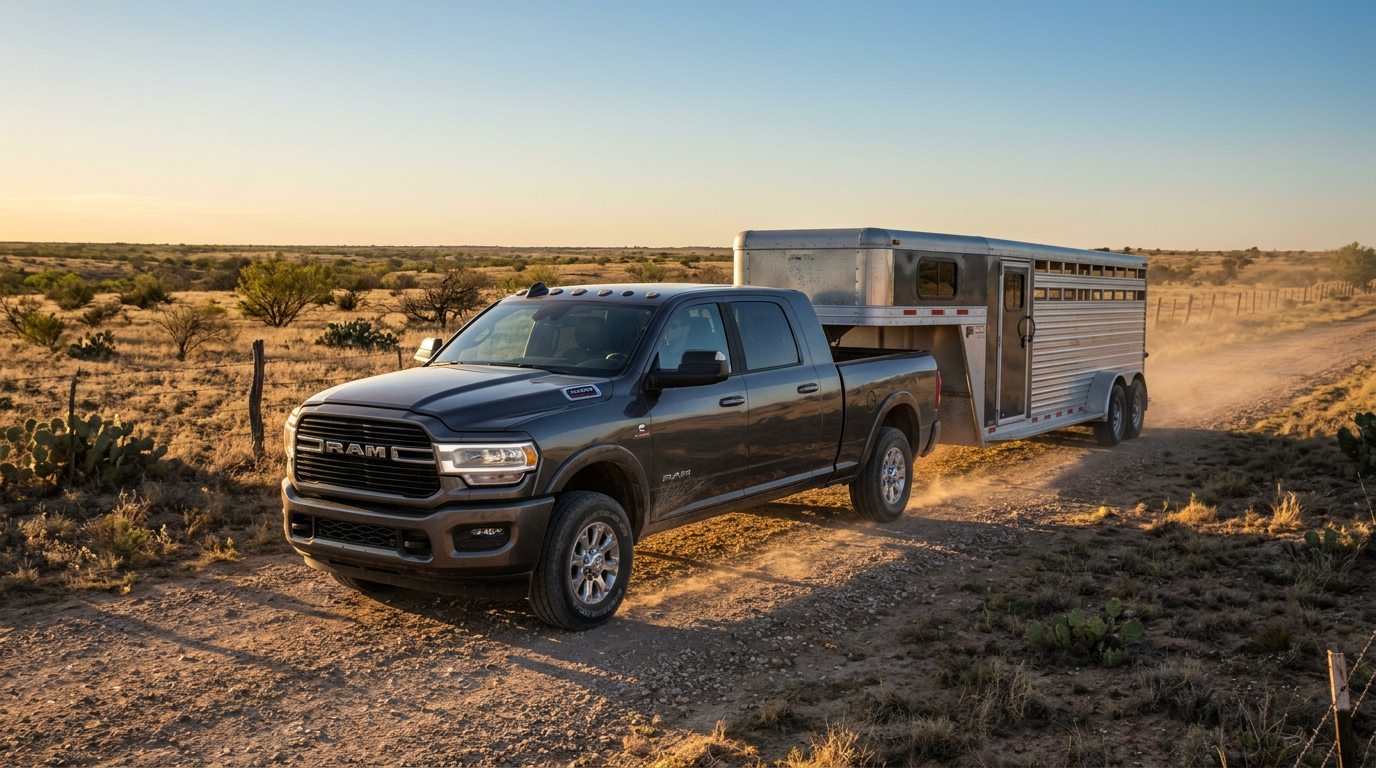
An 8-foot bed places the gooseneck hitch ball directly over the rear axle while maintaining full 90-degree turning clearance between the trailer nose and the back wall of the truck cab without requiring special offset hitches. Selecting an 8-foot bed on a Crew Cab increases overall vehicle length to 261 inches with a 169-inch wheelbase, which widens the turning circle to 54 feet.
Proper hitch positioning is critical when pulling gooseneck cattle trailers across open pastures and farm-to-market roads. In an 8-foot bed, the gooseneck ball installs directly over or slightly ahead of the rear axle centerline. This placement optimizes tongue weight distribution across both axles for stable highway towing. Because the front wall of the bed sits farther forward from the hitch ball, drivers can execute tight jackknife turns while backing into loading chutes without risking contact between the trailer overhang and the truck's rear window.
In contrast, towing a gooseneck trailer with a 6-foot-4-inch bed reduces cab clearance by nearly two feet. Executing a sharp turn with a standard gooseneck coupler in a short-bed truck can cause the trailer nose to strike the back of the cab. Preventing cab damage often requires installing an offset gooseneck hitch ball or a manual slider hitch, which adds weight and height to the bed floor.
The tradeoff for the 8-foot bed's superior gooseneck clearance is physical footprint. Negotiating narrow pasture gates around Baird requires careful planning in a Crew Cab long-bed model. The extended 169-inch wheelbase and 54-foot turning radius demand wider swing angles when maneuvering around cattle pens, narrow barn doors, and heavily timbered fence lines compared to the tighter 149-inch wheelbase of a Crew Cab short-bed configuration.
How Do Engine Choices Impact Payload Capacity and Trailering Fuel Economy?
Choosing the 6.7L Cummins Turbo Diesel may deliver improved fuel economy under heavy towing loads compared to the 6.4L HEMI V8, but the diesel powertrain's heavier curb weight can reduce available net payload capacity. Gas engines provide maximum payload ratings for heavy bed loads, while diesel engines excel at sustained heavy trailering performance.
Engine selection plays a direct role in how a heavy-duty truck performs under load:
- 6.4L HEMI V8: Produces 405 horsepower and 429 lb-ft of torque, mated to an 8-speed automatic transmission. Because the cast-iron gas engine weighs significantly less than a turbodiesel unit, gas-powered Tradesman models offer higher overall payload ratings. For ranches focused primarily on hauling heavy bed loads like gravel, seed bags, or bed-mounted fuel tanks, the gas engine maximizes payload efficiency.
- 6.7L Cummins Turbo Diesel: Generates 430 horsepower and 1,075 lb-ft of torque, paired with the TorqueFlite HD eight-speed automatic transmission. The heavy-duty cast-iron block and turbocharging system add substantial weight to the front axle. This extra weight reduces payload capacity compared to an equivalent gas model, but the massive torque output allows the truck to tow heavy livestock trailers up steep highway grades with minimal gear hunting.
Fuel economy under load is where the diesel powertrain shines. When pulling heavy gooseneck trailers or multi-car livestock loads, the 6.7L Cummins Turbo Diesel maintains combustion efficiency, often achieving improved fuel economy while towing compared to the 6.4L HEMI V8. Over tens of thousands of miles spent hauling cattle across Texas highways, those fuel efficiency gains help offset higher diesel fuel prices and Diesel Exhaust Fluid expenses.
How Does the Ram 2500 Tradesman 8-Foot Bed Compare to the Ford F-250 XL for Farm Utility?
The Ram 2500 Tradesman features a standard rear multi-link coil spring suspension setup that delivers smoother unladen ride quality over rutted pasture tracks compared to the leaf spring suspension on the Ford F-250 XL. Both trucks offer 8-foot utility beds, but Ram’s coil-spring rear axle maintains better tire contact and reduces chassis chatter on unpaved gravel roads.
When evaluating base-trim work trucks for agricultural duty, suspension architecture creates a noticeable difference in daily driving comfort. Traditional leaf spring setups, like those on the Ford F-250 XL, are stiffly sprung to handle heavy weights, which can result in a harsh, bouncy ride when driving across rough fields without a load in the bed. The Ram 2500 Tradesman uses five-link coil springs on the rear axle, dampening sharp bumps while maintaining heavy load support. For ranches desiring precise height adjustments, Ram also offers an available auto-level rear air suspension that lowers the bed for easier gooseneck hitching.
In terms of standard job-site safety equipment, every Tradesman model includes Adaptive Cruise Control and Forward Collision Warning with Active Braking, systems that can bring the vehicle to a full stop even with a trailer attached. Bed utility features like available 115-volt power outlets and bed lighting transform the back of the Ram into a functional field workstation when repairing fences or servicing farm implements away from the barn.
Quick Answers for Callahan County Ranch Truck Buyers
Q: Can standard 8-foot sheets of plywood or lumber fit in a 6-foot-4-inch bed with the tailgate closed?
In Callahan County, ranchers often struggle with hauling standard 8-foot materials in beds shorter than 8 feet, as the 76-inch floor of a 6-foot-4-inch bed falls short. Hauling 8-foot supplies in the short box requires leaving the tailgate down, using a bed extender, or resting the material over the top of the closed tailgate.
Q: Does selecting the Cummins diesel engine reduce the truck's overall payload rating?
Selecting the 6.7L Cummins Turbo Diesel engine reduces available net payload capacity by approximately 600 to 800 pounds compared to the standard 6.4L HEMI V8. The additional weight of the diesel engine block and heavy-duty transmission increases front curb weight, which lowers the remaining payload capacity within the truck's Gross Vehicle Weight Rating.
Q: Is an offset hitch required when pulling a gooseneck cattle trailer with a 6-foot-4-inch bed?
An offset hitch or slider coupler is strongly recommended when pulling a gooseneck trailer with a 6-foot-4-inch bed to prevent cab contact during tight turns. An 8-foot bed provides enough distance between the hitch ball and the rear window to execute 90-degree maneuvers safely with standard gooseneck couplers.
Q: What cab styles offer the 8-foot long bed on the Ram 2500 Tradesman?
The 8-foot long bed comes standard on the Regular Cab Tradesman and is available as an option on the 6-passenger Crew Cab Tradesman. The ultra-spacious Mega Cab configuration is offered exclusively with the 6-foot-4-inch bed.
Q: How does the Ram 2500 rear coil spring suspension perform on unpaved pasture land?
The multi-link rear coil spring suspension absorbs washboard ripples and rutted terrain better than traditional leaf springs, keeping the rear tires planted on unpaved dirt trails. This setup reduces body chatter when driving unladen across open pastures while retaining heavy payload and towing capabilities.
Find Your Next Ram 2500 Tradesman at Blake Fulenwider Chrysler Dodge Jeep
Blake Fulenwider Chrysler Dodge Jeep offers both 6-foot-4-inch and 8-foot beds, catering to diverse ranching needs in Callahan County. For heavy agricultural duties that demand hauling 8-foot supplies flat or pulling multi-head cattle trailers daily, the 8-foot long box offers unmatched operational utility. If crew carrying capacity and tight turning radii around stockyards take priority, a Crew Cab with the 6-foot-4-inch bed delivers an ideal middle ground.
Our team understands the specific trailering and hauling demands of West Texas ranching. We maintain a strong selection of heavy-duty trucks configured for commercial and agricultural work, complete with both gas and diesel powertrains. Stop by 110 N Access Rd in Clyde to compare bed lengths side-by-side on our lot, or give our sales specialists a quick call at (325) 893-1416 to discuss current inventory and custom order options for more information.
© 2026 Blake Fulenwider Chrysler Dodge Jeep of Clyde. All rights reserved.